

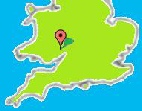









Wye Valley MINIATURE GOLF
Now with two great 12-hole courses:
NEW Indoor ADVENTURE GOLF
Play on our unique course inspired by local legends surrounding King Arthur. Our course lies in the very shadow of the hill where Uther Pendragon first met Vortigern’s wizard Merlin.
You’ll be playing indoors from the Sword in the Stone to the Kings Thorne and the Quest for the Grail. Keep your eyes peeled and you might spot the red and the white dragons, the crown of Arthur and Robin Redbreast.
Find out about our local legends
Outdoor MINIATURE GOLF
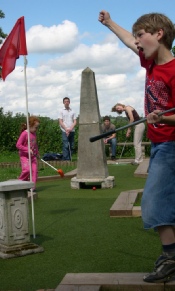
A roman ruin fantasy set in spectacular scenery in the Wye Valley, inspired by roman remains found further up White Brook and on the other side of the River Wye.
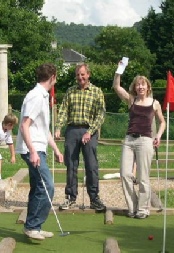
An outstanding outdoor course with all-weather artificial-turf fairways. The design unites a picturesque roman ruin theme, retro minigolf style and adventure golf features for ultimate playability for all ages.
Everyone loves the challenge of minigolf, and this course is a real leveller so you never know who’ll win. Where else can children beat their parents with a club in a fair contest?
Soft or short putters are available, so that even a toddler can play.
Local legends which inspired us
The Sword in the Stone
On our nearest hill about 1,500 years ago, Ambrosius Aurelianus and Uthr Pendragon defeated Gwrtheyrn (Vortigern the Thin) and captured his slave Myrddyn in the fort which gives the hill its name, The Doward (from Llandougarth, “enclosure of two enclosures”). The church at Ganarew was built on Gwrtheyrn’s grave. Myrddyn (Merlin in English) later used magic to disguise Uthr as Duke Gorlois, so as to win the love of the enemy’s wife. Eigr (Igerna or Igraine) welcomed Uthr very gladly, and so Arthur was born at Tintagel. Merlin arranged for the boy to be fostered, and twelve years later got him accepted as Uthr’s heir when Arthur drew a sword from a stone and an anvil - demonstrating that he knew the secrets of a War Leader. Merlin arranged a special coronation at Caerleon, and after mass the guests played games when they hit balls with sticks. Golf was invented by Merlin - Geoffrey of Monmouth said as much.
King Arthur’s Hall
This cave is across the saddle from King Arthur’s Cave, right by Gwrtheyrn’s Fort. The tale about the hall is that Arthur’s treasure was once there, and it had a secret passage to Merlin’s Cave, two miles up the river.
We might expect the usual tale that the treasure had vanished when someone touched it - but no - so was there a treasure at all? Well, Prince Bedwini of Llandougarth was appointed by Arthur to be his Bishop to the Royal Court at Gelliwig near Caerwent. So there was something about The Doward so precious that the hill merited a prince as its custodian. There were at least three iron mines within the fort, and wood to make charcoal for smelting and quarries for limestone - all that was needed to make iron. Merlin’s Cave is hidden in the woods just above New Weir, the site of the biggest ironworks in mediaeval Britain. The industry was supported by nineteen locks on the River Wye, and the first tourists in Britain came to watch its fires from across the river on The Wye Tour in the 18th Century - so there was indeed a treasure in King Arthur’s Hall.
The Assembly of Giants
Vortigern’s name was Irish, although he was raised around the headwaters of the Wye at Rhayader, so maybe it’s no surprise that Ambrosius sent Uthr to punish the Irish for invading Britain by plundering their stone circle, called Cor Gaure, from “Killaraus in Ireland”. The name was translated as Giants’ Choir, but hid a puzzle of meanings: “Cor” could also mean an assembly, ring… or ironically, dwarf. The Saxons named it Stonehenge, because its trilithons looked like gibbets used for hangings. In the story, Merlin moved it to Salisbury Plain and rebuilt it as a monument to four hundred and sixty noble Britons who’d been massacred on “The Night of the Long Knives”:
The Saxon warlord Hengist – son-in-law of Vortigern – had arranged a peace conference. The Saxon hosts made a show of leaving all weapons outside the dining hall as a sign of trust, and each sat next to a Briton at the table. Hengist proposed a toast in his own language, which the Britons didn’t understand - “Nimm euer Seaxes” - “Take up your swords”. All at once, every Saxon drew a sword hidden beneath the table and butchered his guest. This is the reason why, to this day, Germans keep their hands above-table when in company. In time, the brothers Ambrosius, Uther and Constance were also buried at Stonehenge with the victims of that treachery.
Archaeology has proved that the original bluestones were quarried at Craig Rhos-y-felin and Carn Goedeg in Preseli, Dyfed. That’s not Ireland - but it was an area of Irish settlement after the Romans left. The circle was first erected by Neolithic Farmers at Waun Mawn in Dyfed about 5,000 years ago. Six hundred years later they moved it to Salisbury Plain - overland, roughly along the route of the A40. So Geoffrey of Monmouth may have preserved a folk memory of the transit of the bluestones when he put pen to parchment - 3,500 years later - long after the near annihilation of Neolithic Farmers by the Bell-Beaker Folk, and later colonisations by Romans, Anglo-Saxons, Vikings and Normans. However, far older tales were told in these hills…
The Dragon Stone
Vortigern’s power-base had been Caer Gloiu (Gloucester) on the river Severn. At the other end of the Severn is Llanrhaeadr ym Mochnant, where there was a tale of a terrible wyvern – a cattle-raiding dragon. The villagers discovered that this dragon got enraged by the colour red, and it had two lairs. Near the track between them was a menhir (“long stone”, a monolith). They got a blacksmith to fit the menhir with iron spikes. They lured the dragon onto the trap by red cloth over it, which hid the spikes. The wyvern attacked the cloth with such ferocity that it impaled itself right around the menhir. That was the end of the dragon, and the people called the menhir “the red stone” or “the dragon stone” ever after.
But where did this tale come from? Mythologists now think that dragons were invented as a southern African myth about 75,000 years ago as writhing serpents that formed valleys and sweated a milk which made the water in rivers and lakes. Rain falls from clouds, so they needed wings. This beneficial dragon myth spread as far as China, but in the Fertile Crescent a variant evolved that drought was caused by bad dragons which hoarded water underground or in clouds, but water was released if the dragon was killed, flooding the rivers. But the Dragon Stone tale tells of a cattle-raider. That’s from a much later indoeuropean branch of the dragon myth which includes a dragon-slayer… except in Wales. The Bell-Beaker Folk who displaced the Neolithic Farmers and brought metallurgy here were the first indoeuropean people to reach Britain. Welsh DNA is mainly Bell-Beaker, but Wales was a refuge for European Hunter Gatherers, whose DNA survived the Neolithic Farmer occupation in Welsh people. Those farmers had migrated from Anatolia (modern Turkey) where they had learned farming from The Fertile Crescent - where the dragon myth had no dragon-slayer motif. So maybe the Dragon Stone story is a fusion of Neolithic Farmer and Bell-Beaker versions. That raises a question about Geoffrey of Monmouth, accused of pseudohistory since his lifetime: He wrote that that Brutus, the founder of the Britons, was from Troy in Anatolia… but had he appropriated that from the Roman myth of origin, Aeneid, which had arrived in Britain over a thousand years before his time – or had the Britons already merged it with their own folk memory of their arrival as Neolithic Farmers 6,000 years ago?
The Sleeping Dragons
Before the Roman invasion, Britain was invaded by Coriniaid (“Little People”, or maybe “Them of the Circle”). The Britons were deeply troubled by them - from whom they could keep nothing secret – and by an awful shrieking on May Eve which made many people sick, and by nightly theft of food from the Court of King Lludd. He sailed to consult his brother King Llefelys mid-Channel, between Britain and France. At first they used a magic speaking-tube to prevent the Coriniaid from eavesdropping, but a demon made each think that the other’s words were hateful and their navies nearly went to war over it - but wisely they abandoned the bad tech. Llefelys advised ridding Britain of the invaders with poison made from crushed insects (Britons being immune); He thought that the shrieks were from dragons fighting underground at the centre of the kingdom, and advised enticing them to fight on a cloth, gathering it up to drop them into a butt of mead and burying them in the mountains; And to trap the thief, Lludd should lie in wait, taking cold baths to stay alert. Thus the three plagues were ended. Lludd pardoned the thief, and all was well in the land of Britons.
Four hundred years later the Roman invasion had come and gone, and the buried dragons were found in their barrel by Merlin beneath an underground lake that was collapsing King Vortigern’s fortifications. When the cloth – representing Britain - separating the dragons was removed they woke and fought over it to exhaustion, and from that Merlin prophesied repeated wars between Britons and Saxons, so Vortigern kept Merlin as his soothsayer - instead of his intended sacrificial victim.
This time the dragons are NOT cattle raiders, and do no violence to people… so where did these tales come from? “Lludd and Llefelys” was written down in the 12th or 13th Century A.D., but the dragons resemble those in the Sumerian tale “Enuma Elish” in which there was one dragon for fresh and another for salt water - named Marduk and Tiamat. They had wings and fought each other. Marduk won and created the land and sky from Tiamat’s body. In “Lludd and Llefelys” the red dragon symbolised the homeland Britons (red, the colour of the mud left by a river flood); and the white dragon the invaders from over the sea (white, the colour of salt and sand). So the dragons of this tale are probably from a branch of the Enuma Elish myth, perhaps brought to Britain from Anatolia by the Neolithic Farmer migration, thousands of years before the arrival of Celtic culture. The creation element is lost in the surviving tale of Lludd and Llefelys, perhaps because it conflicted with the biblical book of Genesis.
But in the Merlin tale (from “Historia Brittonum”) written in about 830 A.D. - and in the name “Pendragon” (Chief Dragon) - dragons represent armies. That imagery is from the Enuma Elish branch, but reimagined as the tale of Saint Michael the Archangel leading the heavenly hosts to defeat the dragon in Hell - Satan - as told in the biblical “Revelation” about 2,000 years ago. The good versus evil motif had been a feature of Zoroastrianism which got into Judaism during The Exile in Babylon, and so into Christianity, which came to Britain around the time of the Roman Occupation. So the fighting dragons of Merlin could be from a branch of dragon lore which evolved 10,000 years later than the same dragons in the prequel about King Lludd.
And if you think that dragon stories were inspired by fossils, some were, but not fossils of great dinosaurs:
The words dracon, wyevern, gwiber, wyrm and worme were all cognates for “snake”, so ridding land of serpents and slaying dragons were once indistinguishable. Saint Keynwiri (Keyne) was one of Brychan Brycheiniog’s twenty four children, and a sister of Rhain Dremrudd, whose cape of beards was worn by Arthur at Caerleon and was later one of The Thirteen Treasures of Britain obtained by Merlin. Rather than marry, she took holy orders and decided to leave Brecon to be a hermit abroad – a career path known as “choosing martyrdom by travel”. After crossing the Severn, the king there gave her a wood which was plagued by serpents. Her prayers turned them into pebbles – known as “snake stones” (still found in gardens near Tewkesbury). She ended her days on St. Michael’s Mount, a holy hill now called Skirrid Fawr (Ysgyryd Fawr, meaning “cloven hill”) in Herefordshire.
Snake Stones were carried to ward off snakes, the devil – and hair loss. They were said to look like sculptures of coiled snakes, but were in fact fossilised ammonites - shellfish not unlike the Nautilus. In Yorkshire they are linked to the snake slaying Abbess St. Hild, who hosted the Synod of Whitby. She wasn’t Welsh - so she cut off all their heads. And St Patrick, who was carried off from Wales to be a slave in County Antrim, rid Ireland of snakes. Ammonites are plentiful in all those places, which were under the sea in the Jurassic and Cretaceous periods, so forget dinosaurs, it was sea-shells.
More on dragons later…
Merlin’s Cave
A Breton story came to Britain with the Normans: It told that Merlin fell in lust with the Lady of the Lake, Viviane la Fey. She couldn’t stand him - he was old and she was only twelve - but she wanted to learn all his magic. The deal was done, and she being an elf and he the son of a demon, naturally they would live underground. Imagine his dismay when, at the promised moment, he discovered magic words tattooed on her [insert bowdlerism, e.g. “thigh” or “ring”]. He immediately lost his desire for her. When his brother-in-law, Rhydderch Hael, called on him to go to war, Merlin didn’t hesitate. Rhydderch gave Merlin his flaming sword, made by Wayland the Smith, leader of the elves. Merlin went mad, so Viviane put him in chains, and nagged him relentlessly for a spell which would put someone to sleep for ever. Being a prophet, he knew who’d be its victim, so he taught her other magic. So… he who’d helped Uther break his marital vows and have an affair with Igraine - and she who would later help Guinevere break her vows and have an affair with Lancelot - broke their own sworn vows and so were condemned to an eternity of purgatorial partnership.
BUT what of the local tale of the secret tunnel to King Arthur’s Hall? It finishes the Norman tale: Merlin had to escape to amass The Thirteen Treasures of Britain and end up buried at Mynydd Ferthin near where the two had first met, the Siege Dolorous (“Seat of Sadness”) at Ewyas Harold; and the childless Vivianne had to escape too, to go on to foster Lancelot and get him fixed up with Guinevere. This cautionary tale about exogamy and the fairy contract is compiled from Christian and indoeuropean motifs, one of which was teeth - bowdlerised as a tattoo – and now thought by mythologists to be over 7,000 years old.
Five Kings - or Five Kingdoms?
About fifteen hundred years ago, a Pictish monk known as Gildas the Wise wrote a merciless account of the state of Britain. He called it “The Downfall and Conquest of the Britons” (De excidio et conquestu Britanniae”). Britain had once flourished as part of the Roman Empire, and had been a refuge for Christianity through persecutions - and the first Christian country under King Lucius. After the Romans left, it was invaded by heathen pirates, Picts, and Irish. Vortigern (Gwrtheyrn) usurped the crown. Unpopular, unchristian and probably of Irish descent, he was unable to muster a large army from vassal kings with tribal loyalties, Vortigern tried a Roman solution – recruiting Feodorati - mercenaries from overseas… Jutes. He didn’t pay them, then tried to appease them with the land of Kent, but that wasn’t enough. They left, but returned in strength. This was the Anglo-Saxon Invasion and resulted in civil war. Eventually exiles returned from Britanny, beat some of the invaders back, made peace with others, and defeated the hated Vortigern, but much of the island was lost to Angles, Saxons and of course Jutes.
That fight back is the germ of Arthurian legends. Gildas wrote of five kings: Constantine, Aurelius Conanus (Caninus), Vortipore, Cuneglasse (Cynglas) and Maglocune (Maelgwn) - but Arthur wasn’t mentioned, despite being heralded later as “One of the Nine Worthies” whose works led to the establishment of Christendom. Well, Gerald of Wales (who had links with Hereford) wrote that Gildas went on a mission to Ireland. While he was there, his brother Hueil had mocked Arthur’s dancing: Arthur had a leg wound from a fight with Hueil over a woman and so a permanent limp. He got so angry that he had Hueil frogmarched to the town square of Ruthin, and cut off his head. Gildas seethed about it for eight years - then literally wrote Arthur out of history.
Some events in Arthur’s story fit with exploits of three Silurian kings: Tewdrig, Meurig and Athrwys. They united - by conquest, diplomacy and marriage - the kingdoms of Dyfed, Glwysing, Gwent and Erging, and maybe part of Pengwern. Five kingdoms, now the whole of the south of Wales, at least half of Herefordshire, and the Forest of Dean. Their dynasty eventually ruled Morgannwg until the time of Athelstan II. Arthur is not a historic person, but if kings were known by titles rather than names, these real people may have inspired folklore about historic kingdoms of the Silures tribe uniting Cornovian and Demetan tribal territories. Their kings had a tradition of electing an Ameraudur (Commander in Chief) - Dux Bellorum in Latin, Pendragon in Welsh. Arthur was originally described by Nennius in Historia Brittonum - not as king but as “Dux Bellorum”.
The Rant of Gildas
Gildas the Wise had trained under St. Illtyd and lived on Flat Holm. Both men were bell founders, so they could make the sacred “bangu”, a big handbell rung to time psalms during funeral processions - and upon which vows were blessed, respice finem. Here, if you get the ball into Gildas’ pulpit, you’ll hear the sound of the bangu, then your ball will rattle down the steps - emulating the descent into Hell of anyone who broke a vow sworn on the bangu. Gildas raged about the crimes of Arthur’s successor, Constantine (identified as Cystennin Gorneu) in the excerpt pinned to the wall here. Gildas left for Glastonbury, where he helped the Abbot negotiate the release of Guinevere, who had been kidnapped for ransom. Then he went to Brittany along with many other Britons who took tales of Arthur with them.
The meaning of “Gorneu” is usually translated as Cornwall, but could just as well have meant Genoreu (modern Ganarew, about a mile from here), or it may have meant Kernyw, meaning “of the Cornovii (tribe)”. Over five hundred years after Gildas left for Britanny, the Breton stories of Arthur came back to Britain with the Normans, and Geoffrey of Monmouth merged them with Welsh folklore maintained by bards in “Historia Regum Britanniae” which includes the earliest known account of Arthur as a king.
Constantine the Whelp
Arthur defeated his nephew Medraud (Mordred) at Camlann (in north west Wales) but was mortally wounded, so he entrusted his crown to Constantine, a convert to Christianity who had fought at his side. But Constantine was bitter and vengeful. He disguised himself as an Abbot to assassinate one son of Medraud at prayer in a church in London, and the other son in a monastery at Winchester. Shamed by St. Gildas for his perfidy, King Constantine abdicated, and as penance became a monk. He founded the old church (Hen Llan) at Hentland in Mainaur Garth Benni Super Ripam (now Goodrich, two miles from here) on land once given to the church by King Peibiau the Dribbler. He also built a crossing over the Wye to Walford - “Constantine’s Ford” - which was used for 1,300 years until Kerne Bridge was built (Normans built Goodrich Castle to guard the ford). Three years after Constantine’s abdication, allies of Medraud murdered him. He was buried at Stonehenge beside the other heroes of the war against the heathen Saxons, was venerated and eventually made the patron saint of the church at Welsh Bicknor.
Cattle-raiding Dragons
Bards in Britanny passed a story to Norman troubadours from the time of King Arthur which was retold in the Book of Llandaff:
- Saint Dyffrig - who had crowned King Arthur and is the patron saint of this parish - ordained a priest named Samson, and in time consecrated him as a bishop. Samson went to Dol in Britanny. He defeated a lion, a witch and a few dragons, yet (like Daniel in the apocryphal “Bel and the Dragon”) he wielded neither sword nor lance. These monsters all died instantly at Samson’s command, such was his moral authority.
- Mordred - who had dealt the mortal blow to Arthur - gave his name to Mordiford, where the Rivers Wye and Lugg meet. A dragon with three or four pairs of wings made its lair in a coppice near Haugh Woods. It would go down Serpents Lane to the river, poisoning the ground as it went. It stole cattle and was a danger to children - and the miller’s daughter fell in love with it (Maud - she too gave her name to Mordiford). Offers of reward failed to recruit a dragon-slayer, so a condemned prisoner was found named Garstone. He was promised a free pardon if he killed the dragon. He hid in a cider-barrel under the riverbank, waiting to stab the monster through its bung-hole as it went to drink. He dealt the dragon a mortal wound and jumped out to celebrate - too soon. The dragon’s dying breath poisoned him. He died forgiven, and so surely went to Heaven.
- Another dragon lived in Wormsley Wood - “Dragon’s Meadow Wood” - on the other side of Hereford. This dragon had kidnapped a maiden. It was killed by a Roman soldier called George in Lower Stanks Field at Brinsop… which is how St. George became the patron saint of Brinsop church - and eventually of England.
In England, Arthurian tales were kept alive by mummers’ plays (mummer from Mommo, greek god of mockery) and guild pageants which acted out a tale with players masked as a hero (King Arthur or St. George), and various enemies… a dragon, giant, landlord, pirate, crook, or devil – or King Arthur (a Welsh and/or English hero). A “fancy doctor” would resurrect the victims, demand an excessive fee which the hero refused to pay and so was killed by the Doctor. The plays were acted in dozens of Gloucestershire villages, but petered out after the Protestant Reformation. In Herefordshire, their characters remain only in folk tales.
As usual, the dragons are about water: St. Samson drove one into the River Seine; The River Lugg was known as the Tarater (“Trespasser”) at Mordiford because of its floods; and “stanks” is the name given to earthworks built to contain flooding. They were all cattle-raiders that breathed poison or fire, and a human dragon slayer fought them. Dragon slayers had no wings and weren’t backed by an army, so they are not from the St Michael story. They come from the indoeuropean branch of dragon myths found in the story of Trito, who slew a three-headed dragon in a tale about 8,000 years old. The word for cattle eventually got mistranslated as “female”, and so dragons were said to steal maidens and children.
Garstone’s fate is found in “Beowulf”, a Jute tale penned in about 700 A.D. for the Anglian king Offa of Mercia, but Garstone’s name is Norman, meaning “servant” or “boy”. The maiden-taking tale got attached to St George in Syria in the 9th century, and was known to crusaders as “The Golden Legend”. A Steward of Brinsop Manor went on a 3,000 mile pilgrimage to Compostella and so saw an image of St. George at Parthenay-le-Vieux in France. He had it copied onto the gable of Brinsop church. At about that time “The Life of St Samson” was included in the Book of Llandaff, a Wyvern was drawn on the Mappa Mundi in Hereford Cathedral, and the Brinsop image was copied above the south door of Ruardean church in the Forest of Dean. Mummers’ plays marked Twelfth Night (Old Christmas), and pageants marked Corpus Christi with a ritual rebirth motif suggestive of fertility ritual. The plays gave licence to mockery of figures of authority, and were banned from churches. They were an occasion for collecting money for immoderate drinking by the players, so mummery is probably how Mordred, Garstone (allegedly a landowner), Maud (impugning the miller’s family) and a cider barrel got into the story at Mordiford.
Arthur’s Stone
The young Arthur had fought a giant on Merbach Hill near Dorstone, during which the capstone of the dolmen got cracked. The battle was celebrated annually by a fair there until the mid 19th century. The story is recognisable as mummery mocking Rhain Dremrudd of Brycheiniog. His name meant “Ruddy Red-beard” and a fort on Aconbury Hill overlooking Hereford was named Caer Rein after him. Rein or Retho had threatened to beard Arthur after the upstart youth had humiliated King Peibiau of Erging and his brother King Nyniaw: Arthur had yoked them to plough like dribbling oxen for going to war over sheep grazing on the Black Mountains, so Peibiau the Leper became known as Peibiau the Dribbler, although it was also said that he dribbled because Arthur had bearded him. Arthur bearded Rein and took his mantle – made from the beards of the giant’s defeated enemies. He wore that trophy at his coronation at Caerleon. There he was crowned by Dyffrig, a grandson of Peibiau who’d cured the king of leprosy and is the Patron Saint of this parish (a.k.a. Dubricius or Tiburcius in Latin, Devereaux in French). Dyffrig abruptly resigned his post and wisely became a hermit on Bardsey, “the Isle of Bards” - or is that a beard pun? It was told that a town had sunk into the ground near Arthur’s Stone, leaving only a hollow with a pond in it, and the tip of the church spire was seen there during droughts. In Britonnic lore, the underworld is either drowned land or in a hill, but on Merbach Hill it is both drowned and in the hill.
The Kings Thorne
Five hundred years ago the Barbours’ Guild pageant in Hereford depicted the tale of “Joseth Abarmarthea” (St. Joseph of Arimathea), a tin trader who’d known the child Jesus, brought Him to Britain, and later brought the relics of Jesus to Britain and built the first church in the world at Glastonbury, where he converted converted King Arviragus. And so it was that Constantine the Great - a Romano-Briton raised as a Christian and declared Roman Emperor in York – legalised Christianity 300 years later. This tradition explains William Blake’s lyrics of the hymn “Jerusalem”. Joseth’s sister was an ancestor of King Arthur, so Tudor monarchs claimed descent from him. That’s why our Monarch has the title “Fidei Defensor” (Defender of the Faith). The Stuart king Charles I styled himself “Arthur redivivat” and arrogantly used Arthur’s Stone as a dining table in 1645.
Joseth had rested near Glastonbury, stuck his staff in the ground and it instantly took root and flowered - the miracle of the Holy Thorn. A sprig of it was sent to reigning monarchs by the monks of Glastonbury Abbey at Christmas. Charles I gave one to the Mayor of Hereford, and from it grew a scion called “the Kings Thorne”. near The Castle Inn at Little Birch on Aconbury Hill. After Charles was martyred for his belief in The Divine Right of Kings, the King’s Thorne flowered for an hour at midnight on Twelfth Night (“Old Christmas”) - during which all cattle knelt in their byres in sorrow – and it bloomed again at Easter. The Kings Thorne survived for three and a half centuries. Although Celtic Christianity was dissolved in this area in 777 A.D., the legend of Joseth lived on, and King Arthur was celebrated as one of “The Nine Worthies” (three heathens, Jews and Christians by whom Christianity flourished) because his defence of Britain helped Christianity survive annihilation.
The Quest for the Holy Grail
West Midlands Constabulary went on a fruitless quest for The Grail in 2014 after it was stolen from Weston-under-Penyard near Ross-on-Wye. A woman there had been lent a wooden mazer (drinking bowl) which had been saved from Strata Florida by its monks when Henry VIII had dissolved the abbey. Treasured for 400 years by the Jones and Powell families of Nanteos in west Wales, some believed the cup - “Cwpan Nanteos” - to be the Grail, the cup used by Jesus at The Last Supper which had been sent to Britain by St. Joseph of Arimathea after he’d arranged the funeral of Jesus. Drinking holy water from the cup was thought to cure sickness. The Dingestow Brut manuscript tells that Eigr, Arthur’s mother, had been a descendant of Joseph’s sister, and her grandfather had once been Custodian of The Grail - which explains King Arthur’s obsession with finding the lost relic. Cwpan Nanteos was handed in anonymously after eleven months and is now curated by the National Library of Wales at Aberystwyth.
Are these stories true?
HIC SVNT DRACONES (“Here be dragons”)
- the Hunt-Lenox Globe, 1508
“It is all true, or it ought to be; and more and better besides. And wherever men are fighting against barbarism, tyranny, and massacre for freedom, law and honour, let them remember that the fame of their deeds, even though they themselves be exterminated, may perhaps be celebrated as long as the world rolls round. Let us then declare that King Arthur… slaughtered innumerable hosts of foul barbarians and set decent folk an example for all time”.
- Winston Churchill
“Be bow bendit
My tales ended
If you don’t like it
You may ‘mend it.”
- Traditional end for Herefordshire folk tales
Acknowledgements:
Special thanks to Dr. Jon White of “Crecganford” and the Folklore Database for his academic mythography, also Richard Johnson of “O’r Golwg”, Dr. Gwilym Morus-Baird of “Celtic Source”, and Caleb Howells for their works on on Celtic lore and historicity, Bruce Coplestone-Crow and Ella Mary Leather for their books on local placenames and folklore.
Go to TOP